Our brain is made up of billions of brain cells called neurons. The combination of neurons sending signals at once, produces an enormous amount of electrical activity in the brain. These synchronized electrical pulses from masses of neurons communicating with each other produces ‘Brainwaves’. Brainwave speed is measured in Hertz (cycles per second) and they are divided into bands describing slow, moderate and fast waves.
Brainwaves are generally broken down into five main frequencies: Beta waves, Alpha waves, Theta waves, Delta waves and Gamma waves.
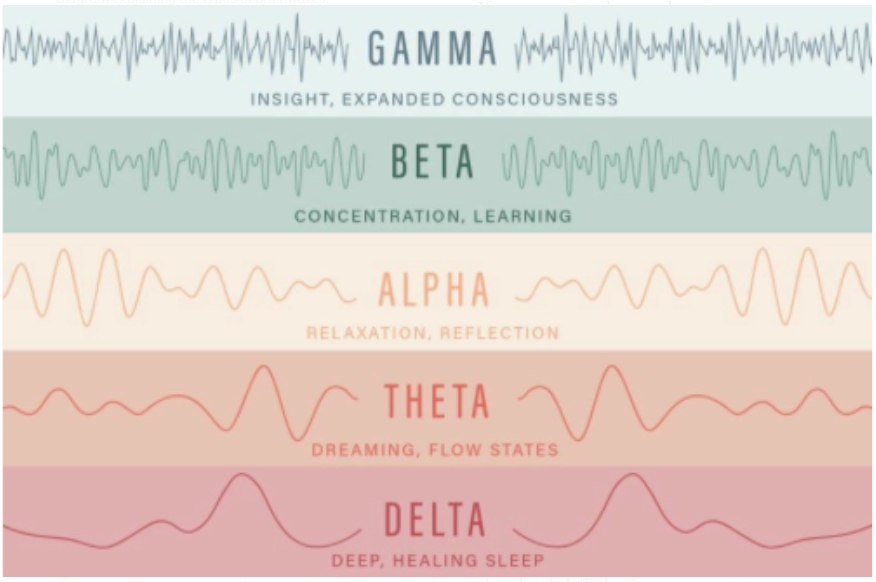
Gamma 25 – 100 Hz
There is a correlation between transcendental mental states and gamma waves. Meditation master all have in common the ability to put the brain into a state in which it is maximally sensitive and briefly consumes power at lower (or even zero) rate.
In a 2004 study done by researchers at the University of Wisconsin, brainwaves from eight long-term Tibetan Buddhist practitioners of meditation were compared to brainwaves of meditation novices. The study had these subjects meditate one hour for one week prior to observation. In a normal meditative state, both groups have shown to have similar brainwave activity. However, when monks were asked to generate a feeling of compassion during meditation, their brainwaves begun to oscillate in a rhythmic and coherent manner, in harmony, showing frequencies of gamma frequency band, 25-40 Hz, highest oscillations ever recorded in human brain (apart from those in erratic, abnormal states, such as seizures). In case of novice meditators, these gamma wave oscillations were rare in the beginning, nonetheless, number of rhythmic harmonic oscillations increased with further experience, implying that this state can be achieved by training.
This supports the consideration that human brain is neuroplastic – we can train our brains to alter neural pathways and achieve positive effects on our physical and emotional health. Evidence and research in gamma-band oscillations show the relation between such state and heightened sense of consciousness, bliss and intellectual sharpness subsequent to meditation.
Beta 12 – 25 Hz
We are in beta frequency range during our normal waking state – from when we get up until we go to sleep. We focus our intention to our external, physical realities, we are attentive, alert, focused. Chemicals that stimulate this brainwave ranges are nicotine, caffeine and amphetamines.
Activating lower beta frequency bands can lead to relaxed focus and improved attention (relates specifically when body is in motion), as well as increase of our mental abilities and IQ.
Higher beta frequency bands (20 – 25 Hz) is when we are in high alert, often also anxious (fight or flight response). Staying in this state creates chronic stress and anxiety, decreasing effectiveness of our immune system.
Alfa 7.5 – 12 Hz
We are in alpha frequency range when we first wake up in the morning and just before we go to sleep. Alpha waves are associated with relaxed but conscious state. We can experience this state when we daydream or enter a light meditation, with our eyes closed (that is when the brain starts to produce alpha waves), it is when we are conscious, but we maintain passive awareness. A healing effect can also occur because we are vibrating in harmony with Earth’s natural frequencies. Neurotransmitters and hormones such as endorphins, dopamine and serotonin are released into the system, whereas blood adrenaline levels in the system decrease – bringing us ease.
Alpha waves are also used during hypnosis to re-program mental consciousness.
Being in alpha frequency brain state heightens our imagination, visualization, memory, learning and concentration. It can help us heal phobias and overcome stress. It can also help to calm down hyperactive children and assist children with stuttering issues to relax enough to speak normally.
We use therapeutic sound to stimulate this healing state of consciousness, and to facilitate the transformation of self – to see through the illusion of life and realization of the true nature of reality.
Theta 4 – 7.5 Hz
We are in theta frequency range when we are sleeping. Theta waves are associated with sleepiness or somnolence, with deep states of meditation, peace and calm. In this state we can access tranquillity and extreme relaxation. Daily sleep is necessary for the physical body to rest. Our most memorable dreams occur in this brainwave state, as well as rapid eye movement (REM) sleep, lucid dreaming and out-of-body experiences.
Somnolence [sŏm′nə-ləns ]
-a state of strong desire to sleep or sleeping for unusually long periods
-a state intermediate between sleeping and waking.
Theta brainwave state is related to higher mind functions or extrasensory perceptions such as clairvoyance (‘’clear seeing’’), clairaudience (‘’clear hearing’’) and clairsentience (‘’clear feeling’’).
Theta waves are also used during hypnosis, and to re-program mental consciousness by using for example recorded, positive affirmations.
Alpha-theta border state 7.8 Hz
This is a state in between two worlds, as they say. We are in a deep meditative state but at the same time we have passive awareness. Being in this relaxed, dreamy, sleepy state we are attuned to Earth’s resonant frequency, enabling us deep healing and cell regeneration.
Therapeutic sound is used to enter this state for purposes of healing, and it has been used by ancient civilizations for many millennia.
Delta 0.1 – 4 Hz
We are in delta frequency range when we are in deep dreamless (non-REM) sleep. We are then completely physically unaware of our surroundings. It is the dominant rhythm in infants.
It has been found that healing can occur also within this frequency range. Being in delta state is crucial for restoration and rejuvenation. This frequency band has the highest amplitudes and the slowest waves.
 buddhna