The name ´singing bowls´ is coined because these metal alloy bowls produce beautiful harmonic tones and overtones when played – as if they are singing. The pitch of each bowl, or better to say, set of tones, depends on their size, shape, and thickness. If we use an electronic chromatic scale detecting device (tuner), we can measure different harmonics that are created within the bowl while played. The notes can also change depending on the wand/material/technique we use to play them.
The name ´singing bowls´ is coined because these metal alloy bowls produce beautiful harmonic tones and overtones when played – as if they are singing. The pitch of each bowl, or better to say, set of tones, depends on its size, shape, and thickness. If we use an electronic chromatic scale detecting device (tuner), we can measure different harmonics that are created within the bowl while played. The notes can also change depending on the wand/material/technique we use to play them.
harmonics are waves whose frequencies are integer (whole numbers) multiple of the frequency of a fundamental tone
History
Assam, Sikkim, Bhutan, India, China, Burma, Nepal, Thailand, Cambodia, Korea; Japan
– Frank Perry; Himalayan sound revelations
It is believed that the first Tibetan, or more appropriately, Himalayan singing bowls – as they originate from the broader Himalayan area and several countries date back several millennia, yet their exact history is enveloped with mystery, and very little information is written and available today.
Singing bowls originated from Chinese bells and were developed during The Great Bronze Age (ca 3500 BC – 250 BC), when a significant development and artistic sophistication in the working and production of metal objects and tools took place.
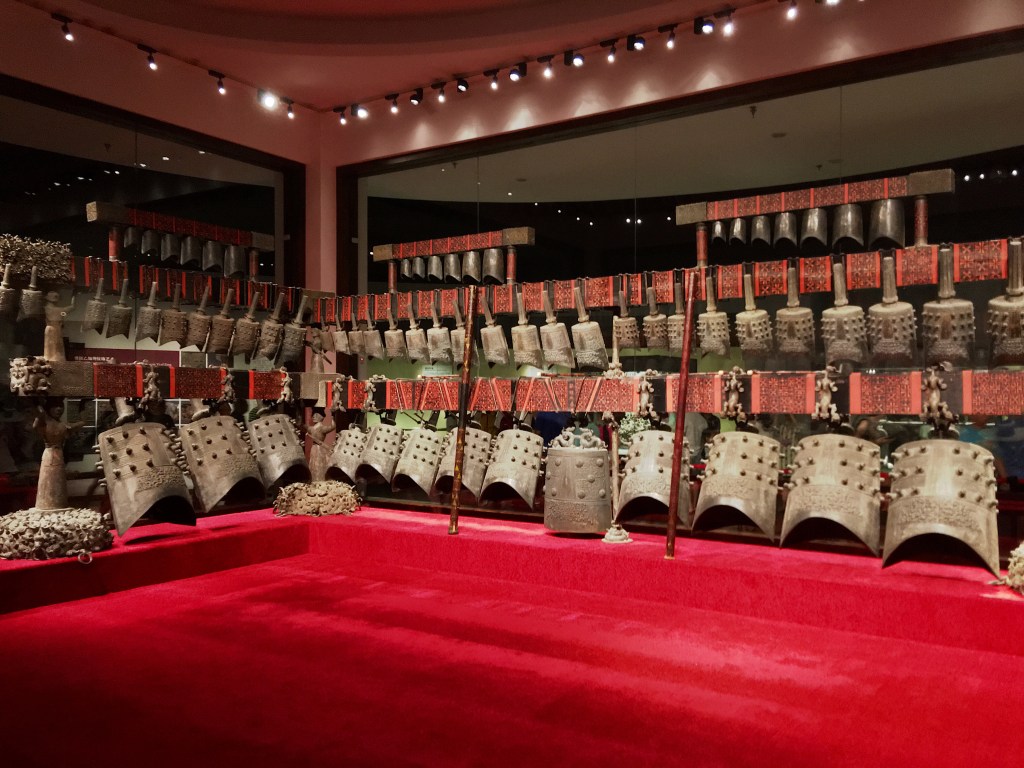
Chinese population maintains an ancient religious and spiritual belief that all things have an innate life form of energy, called ´chi´. It is assumed that in the production process each precious tool and object would have been invoked with various energies, and blessed and consecrated according to the person the tool was created for.
Tibetan singing bowls envelop Chinese astrological concepts and knowledge, used in Tibetan Buddhism, as well as teachings of Bon (Bonpo) – native pre-Buddhist religious tradition of Tibet, and teachings from ancient Hindu scriptures of Veda.
The Vedas, meaning “knowledge,” are the oldest texts of Hinduism. They are derived from the ancient Indo-Aryan culture of the Indian Subcontinent and began as an oral tradition that was passed down through generations before finally being written in Vedic Sanskrit between 1500 and 500 BCE
The Vedic scriptures contain understandings of astronomy and wisdom about planetary associations – ´raga´ is a sacred form of Indian music used for spiritual purposes, which reflects the movements and sounds of planets. Hindus assigned a note to each of the planets.
The opening up of Tibetan religious and spiritual philosophies to Western culture happened mostly after China´s invasion of Tibet in 1950, when many lamas traveled to Western countries, teaching about their culture and spiritual traditions.
The spiritual leader of Tibet, Dalai Lama, began spreading awareness and interest in Tibetan Buddhism worldwide. Tibetan Buddhist practices involved ritual objects such as sacred sound instruments – including singing bowls and it was then they became available in increasing numbers to the Westerners.
Composition and making of the bowls
Tibetan bowls were hand-made from a combination of several metals (usually seven) and their making is an ancient art form with each individual artisan family having a unique signature, with their own recipes, production techniques, as well as blessings and consecrations, passed on from generation to generation.
The suppression of traditional ways incurred after the invasion of Tibet, when many artisan families ceased with the production of sacred bowls. Yet, there is information (not confirmed) that some families have escaped to Nepal and other regions to continue producing singing bowls in traditional ways. It is also believed that some of the families stayed in Tibet and continue to this day producing singing bowls in secrecy, using ancient ways.
Every bowl produced in the traditional way is unique. The bowls might have mantras or words, lines or deities carved into them. They vary in colour as well – from every possible tone of gold to brown and charcoal colours. Every bowl is uniquely individual by the way of the hand-made method of production forming unique shapes and patterns, aligned with a specific point in time and associated with astrological connections. The life of the bowl – its history – leaves on its surface a patina and in its body an energetic imprint of how, where and by whom it has been used.
Unfortunately, due to the popularity and high demand for Tibetan singing bowls, many bowls in circulation have been machine-made and mass-produced. It is possible, however, to place extra focus when obtaining a bowl, contacting the place where the bowls are acquired and assuring that the bowls are made in a traditional way.
However, the intention given to any bowl when played represents an important role in honoring and devoting one´s energy work to the ancient masters and makers of these beautiful instruments and invokes ancient energy into the bowls.
Planetary associations
Number seven is seen as a mysterious, mystical, and very powerful number – there are seven energy centers in the body, seven colors of the rainbow, seven notes on the scale, seven days of the week as well as seven spheres of existence. It takes seven years for the cells in the human body to rejuvenate, regenerate, and renew, so seven can be related to cycles of evolution and growth as well.
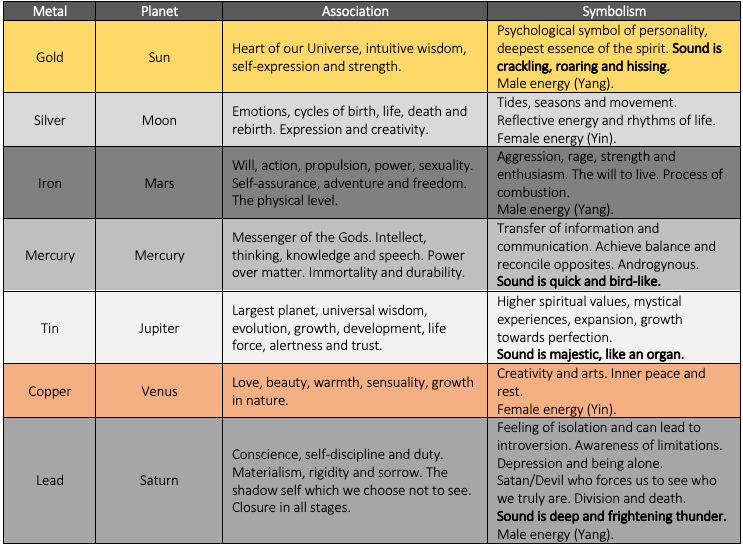
Metals used in the production of singing bowls are assigned to one of the planets of the Solar system and so each of the metals incorporated invokes the energies associated with the respective planet.
Singing bowls are universal instruments which when played symbolize our devotion and surrender as multidimensional beings created by universal Divine consciousness, however, one may call it in different religious concepts. Playing bowls strengthens our sense of connection to everything that is contained within the whole universe and reminds us that we are all connected and not separated.
Working with the bowls, and playing them, invokes the notion of the vibratory character of the macrocosm (the planets) manifestation onto the microcosm of the singing bowl, which is linked to the seven planets:
Some rare old and ancient bowls contain the inclusion of iron ore from the meteorites, which landed on the planet millions of years ago. The meteorite content has its own unique vibration and tends to resonate with spiritual energies that are beyond human spirituality. Being truly of extra-terrestrial origin, the meteorite can act as a cosmic or intergalactic messenger. Its sound can be described as otherworldly.
Symbolism
Understanding the hidden symbolism of the bowl and the wand can lead to a deeper and more profound relationship between you and the bowl.
The bowl represents feminine energy and the wand masculine energy.
Feminine energy or principle is connected to the womb (symbolizes caring, nurturing, healing, giving life), intuition and creativity. It is also connected to the moon and the human emotional body. The bowl is round, circular, with no beginning and no end – representing wholeness, oneness, and endless possibilities.
Masculine energy or principle is connected to action and dynamic, releasing / dissolving blocked energy. The wand is a symbol of manifestation and realization. Manifestation is possible using the wand in connection with endless possibilities contained in a bowl and it is the wand that is the active force enabling endless possibilities to manifest.
Every living being contains both feminine and masculine aspects within them. The union of the wand and bowl represents an act of creation (manifestation) by balancing both aspects and thus creating harmony. Combined with an intention for positive healing outcomes it can lead to the realization of endless possibilities in accordance with Divine will.
Sources: Sound Healing Academy, F. Perry – Himalayan sound revelations
 buddhna